How much concrete do I need is the first question on almost every job we price, and getting it right saves money and stress on the day. The sum itself is simple: length times width times thickness, all in metres, gives you cubic metres. The skill is in measuring properly, handling odd shapes and adding the right margin. This guide shows you how, with worked examples for the jobs we pump most often on the Costa Blanca.
Short answer: Multiply length by width by thickness in metres to get cubic metres (m³). A 6 by 4 metre patio at 12 cm thick needs 2.88 m³. Add around 5 to 10 percent for uneven ground and losses, and check structural work against your engineer's drawings.
How much concrete do I need? The basic formula
Volume in cubic metres equals length times width times thickness, with every measurement in metres.
The only trap is the thickness. People measure it in centimetres and forget to convert: 10 cm is 0.10 m, 12 cm is 0.12 m and 15 cm is 0.15 m. Put 12 instead of 0.12 into the sum and your answer is a hundred times too big.
- Measure the length and width of the area in metres.
- Decide the thickness and convert it to metres.
- Multiply the three figures together to get m³.
- Add a margin, usually 5 to 10 percent.
- Round up to a sensible figure for ordering.
Thickness is not something to guess. It depends on the use, the ground and the reinforcement. Our article on how thick a concrete slab should be gives typical figures for paths, patios, driveways and house slabs.
Worked examples for common jobs
These examples cover the jobs we pump most often, from a shed base to a villa ground floor.
| Job | Size | Thickness | Volume |
|---|---|---|---|
| Shed or summerhouse base | 3 x 3 m | 10 cm | 0.9 m³ |
| Patio | 6 x 4 m | 12 cm | 2.88 m³ |
| Single garage slab | 6 x 3.5 m | 15 cm | 3.15 m³ |
| Liquid screed | 80 m² floor | 5 cm | 4.0 m³ |
| Driveway | 15 x 3.5 m | 15 cm | 7.88 m³ |
| Strip footings | 30 m long, 0.6 m wide | 0.5 m deep | 9.0 m³ |
| Ground floor slab | 12 x 10 m | 15 cm | 18.0 m³ |
The figures before margin are exact for the sizes shown. Your own job will differ, but the method is the same. For footings, the depth is the depth of concrete in the trench, not the depth you dug if part of it is filled with gravel or blinding.
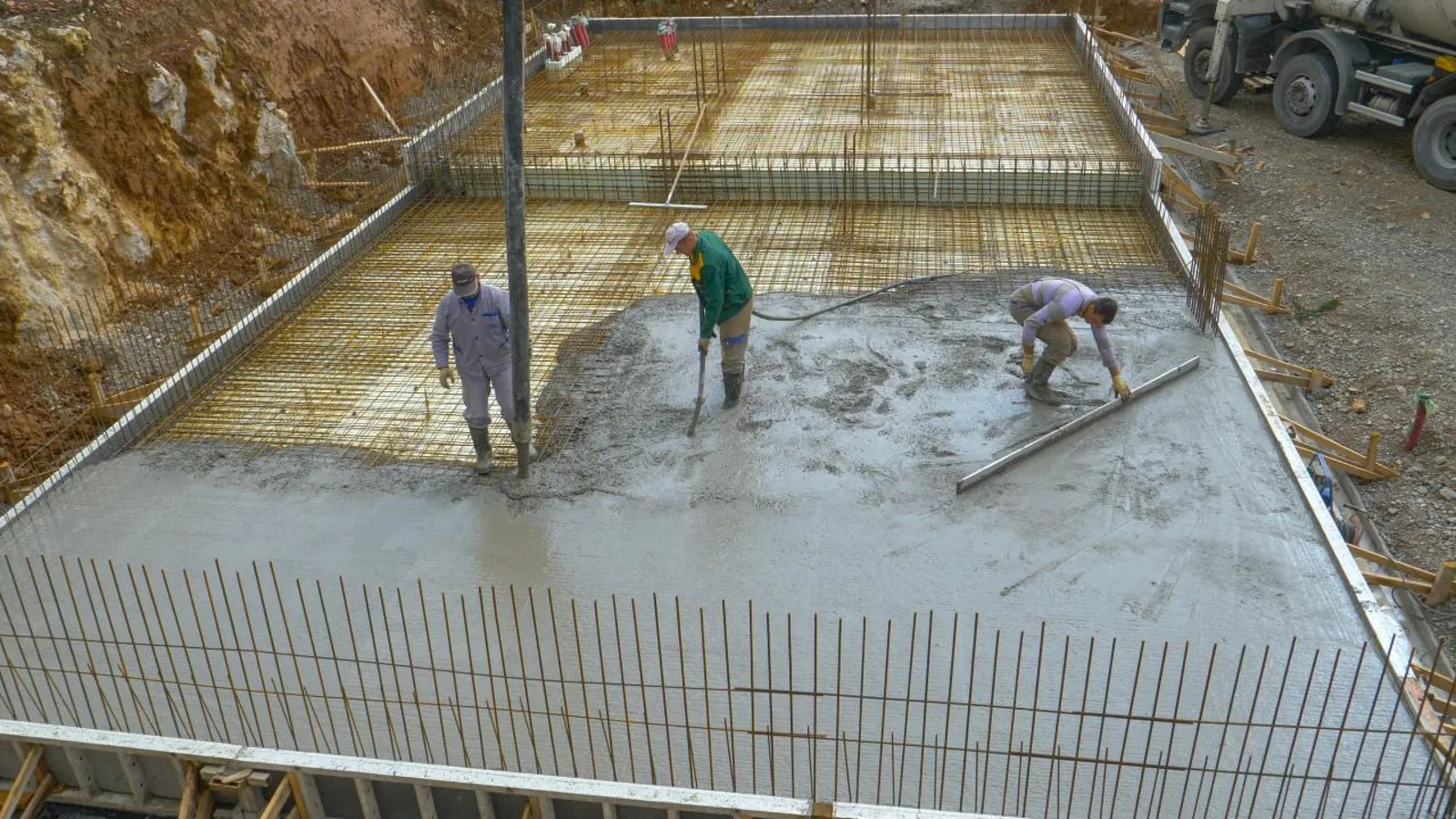
For scale: our real jobs include 20 m³ of concrete in Moraira and 7 m³ of self-levelling screed in Finestrat. A typical concrete driveway or patio sits between those two and the shed base at the top of the table.
Round shapes, slopes and odd areas
Split an awkward area into simple shapes, work out each one and add them up.
L-shapes and irregular patios
An L-shaped terrace is two rectangles. Measure each, calculate each, and add the results. For a curved edge, draw a rectangle that fits inside the curve and estimate the leftover strip separately.
Circles
The area of a circle is 3.14 times the radius times the radius. A round patio 5 metres across has a radius of 2.5 m, so the area is 3.14 x 2.5 x 2.5 = 19.6 m². At 10 cm thick that is 1.96 m³.
Uneven ground and slopes
On sloping plots the thickness is rarely the same everywhere. Measure the depth from the string line or formwork top to the sub-base at several points, perhaps every two metres, and take the average. Terraced gardens and hillside plots are common on this coast, and this is where most volumes go wrong.
Operator's tip: Measure the depth after the sub-base is compacted, not before. Gravel settles, and a few centimetres across a large slab soon adds up to an extra cubic metre.
How much extra concrete should you order?
Order around 5 to 10 percent more than your calculated volume, depending on how even the ground is.
The margin covers small differences in depth, formwork that bows slightly under the weight of wet concrete, and the small amount that stays in the hopper and line at the end of the pour. On a flat, well prepared slab with rigid formwork, 5 percent is usually enough. On rough ground, or where the depth varies, lean towards 10 percent.
Running short is worse than a little left over. If the pour stops while a part load is ordered, the first concrete starts to set and you risk a cold joint where new meets old. On the other hand, ordering far too much means paying for concrete you cannot use. That balance is one of the reasons volume features so heavily in concrete pump hire cost.
How much concrete do I need for a swimming pool?
For a pool you add the floor and the walls together, using the thicknesses on your engineer's drawings.
Take an example pool of 8 by 4 metres, 1.5 metres deep, with a 20 cm floor and 20 cm walls. The floor is 8 x 4 x 0.20 = 6.4 m³. The walls run round a perimeter of 24 metres, so they are 24 x 1.5 x 0.20 = 7.2 m³. Together that is 13.6 m³, and with a 5 percent margin you would order about 14.3 m³. Using the outside perimeter slightly over-counts the corners, which is a small safety margin in itself.
Real pools vary a lot. Steps, a deep end, a beach entry or thicker walls all change the figure, and the build method matters too. One of our real projects was 18 m³ for a pool in Alicante. Our step-by-step guide to building a concrete swimming pool in Spain explains how floor and walls are usually poured, and our pool concrete page covers what we supply.
From cubic metres to lorries and pumping time
Once you know the volume, you can see how many mixer lorries are needed and how long the pour will take.
A full mixer lorry usually carries several cubic metres, often 6 to 8 m³, so an 18 m³ slab arrives in about three loads. We order the concrete from the batching plant ourselves, time the lorries with the pump and put the concrete on the same quote.
Our pumps deliver 16 to 18 m³ an hour, so the pumping itself is rarely the slow part. On a large open slab the pour moves quickly. In a narrow trench or a pool wall, the pace is set by placing and vibrating. For the order of events on the day, see our concrete pour checklist.
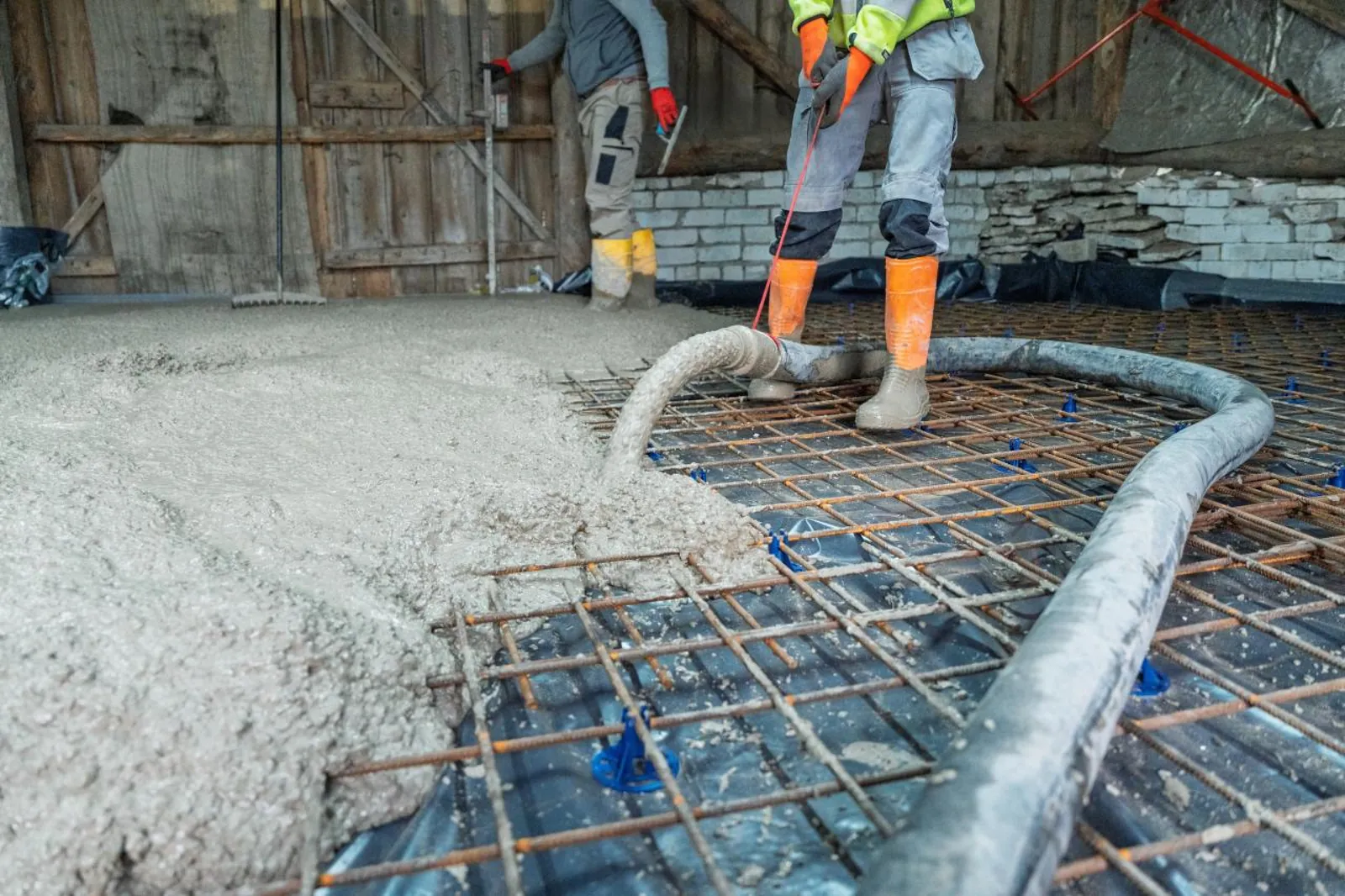
The same arithmetic applies to liquid screed: floor area times thickness. Screed is laid at a minimum of 2.5 cm, so even large floors often need only a few cubic metres.
Check your figures before you book
Send us your measurements and we will check the volume with you before we quote.
We do this on every job. Builders usually have the volume from the drawings, and we simply check it against the access and the line we need. Owners often send a sketch and a few photos, and we work it out together. If the access is tight, our narrow access concrete pumping service takes the line where the mixer lorry cannot go.
The quote covers the pump, operator, lines, setting up and cleaning up, plus the concrete from the plant and any extras. Our prices page explains what affects the total, and concrete pump hire with an operator shows what the service includes. When your figure is ready, send it to us for a fixed price. We can usually book the pour within three working days.
Frequently asked questions
How do I calculate cubic metres of concrete?
Multiply length by width by thickness, all in metres. A slab of 5 by 4 metres at 10 cm thick is 5 x 4 x 0.10 = 2 m³.
How many square metres does 1 m³ of concrete cover?
At 10 cm thick, 1 m³ covers 10 m². At 15 cm it covers about 6.7 m², and at 20 cm it covers 5 m².
How much extra concrete should I order?
Usually 5 to 10 percent above the calculated volume. Use the higher end on uneven ground or where the thickness varies.
What is the minimum amount of concrete you can pump?
We pump small jobs as well as large ones, from a shed base of a couple of cubic metres upwards. Send us the details and we will tell you if a pump makes sense.
Can you work out the volume for me?
Yes. Send us the measurements, a sketch or the drawings, and we will check the figure with you before we give a fixed price.